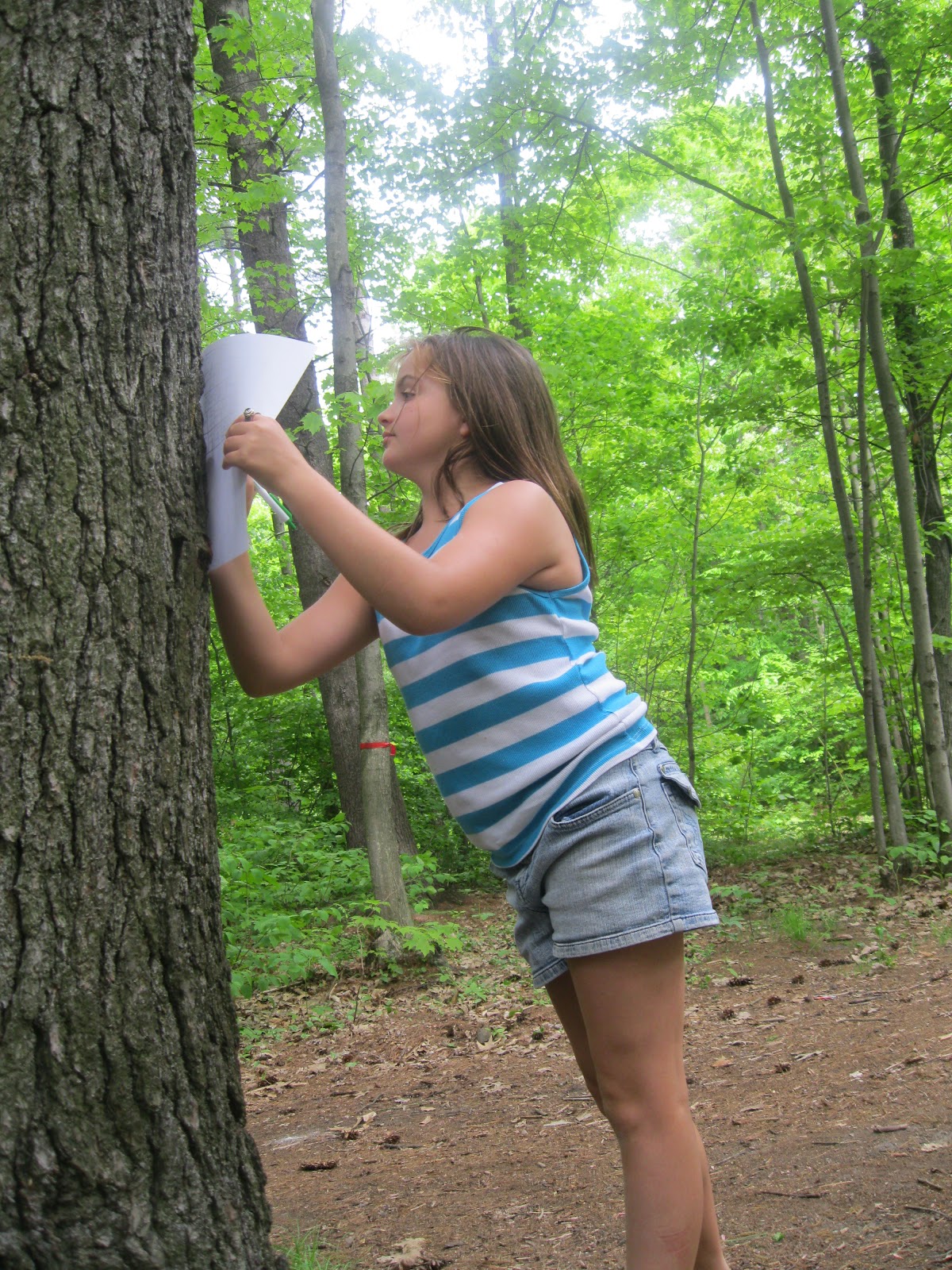
I made a new, improved simple key for tree identification. It's geared to narrow down some of the common types of trees in Vermont, in a simple, kid-friendly way. Print off a copy, try it out, and let me know what you think! If you have trouble with it, let me know and I can help you out.
Then, once you get good at using the simple dichotomous key, you can continue to improve you tree identification skills with a more detailed key. There are many available in book form and online, I would suggest trying a few out to see what style works best for you.
Happy identifying!
~Lisa
Showing posts with label Activities. Show all posts
Monday, July 21, 2014
Saturday, June 30, 2012
Milton Camp
We had an amazing week! I ran a "From the Ground Up" program in Milton, and we learned and explored and played all over the park. As the name (and previous version of the program) suggests, we started out on the first day talking about soil, geology, and hydrology, worked up to plants and trees, then animals, then weather and astronomy. We looked at how each builds on the foundations provided by the other aspects of the natural world.
We climbed a few trees that blocked the trail
The tidbits that stuck with the children during this week made me smile. For example, after discussing soil layers the first day, all week any leaves were called O layer and any bare soil was the A layer. "Look Lisa, we're walking on the A layer!"
This group's creativity astounded me. I taught them the vocab word "snag" (Remember? A favorite of the little lady's.) Then we reached a fork in the trail, I asked them to "hang a right," and they countered with "don't you mean snag a right?" And when I asked them not to touch something, like an animal that's just minding its own business, they said "Yeah, we should leaf it alone!"
They also liked to call the puddles we passed "frog mansions." I loved that. We spooked a frog into the water, and then found it under the mud. It was amazing, the frog stayed stock-still, even when we were pushing it through the water. It was firmly dedicated to pretending to be a rock. I hadn't seen that before!
They all loved to be able to identify and use jewelweed, because it's so useful if you get a cut, sting, or poison ivy exposure in the woods. Each of them was able to identify it by the end of the second day.
I had planned on spending most of the time outside, and then some weather happened. Thankfully we had some activities that were better suited to indoors, such as astronomy. I had a map of the stars visible in summer in Vermont for each of them. They used it to design their own constellations that they could actually find in the night sky!
Ned is my personal pet, I just got him this year (he's probably only two years old!) When I asked each of the kids what their favorite part of the week was, they each said, without hesitation, "Holding Ned!"
Another favorite activity was playing "Star-Nosed Mole." While we played a lot of games and activities this week, the kids asked to play a few rounds of this game every day! One girl really loved the game because she was "really into worms." I've never heard that one before, but, whatever floats your boat!
The group dynamic really affects the way a lesson goes. I always have a lesson plan, but I stay very fluid so if the kids show particular interests then that's what the lesson will become. For example, we spent a good chunk of time discussing wild edible foods. One of the kids even taught me that you can make a dessert out of the seed pods of timothy grass! We found a lot of wood sorrel, which looks like clovers only has heart-shaped leaves and tastes a bit lemony. We also saw a lot of strawberry plants (with no fruit yet) and blackberries!
The whole week was full of special discoveries and hypotheses:
Other good finds include a beaver stump near the swamp, some insects with unbelievable coloration, and many, many red efts!
Someone dug this trench and so we were able to see soil layers!
This group's creativity astounded me. I taught them the vocab word "snag" (Remember? A favorite of the little lady's.) Then we reached a fork in the trail, I asked them to "hang a right," and they countered with "don't you mean snag a right?" And when I asked them not to touch something, like an animal that's just minding its own business, they said "Yeah, we should leaf it alone!"
They also liked to call the puddles we passed "frog mansions." I loved that. We spooked a frog into the water, and then found it under the mud. It was amazing, the frog stayed stock-still, even when we were pushing it through the water. It was firmly dedicated to pretending to be a rock. I hadn't seen that before!
They all loved to be able to identify and use jewelweed, because it's so useful if you get a cut, sting, or poison ivy exposure in the woods. Each of them was able to identify it by the end of the second day.
Rubbing jewelweed on a mosquito bite for relief
I had planned on spending most of the time outside, and then some weather happened. Thankfully we had some activities that were better suited to indoors, such as astronomy. I had a map of the stars visible in summer in Vermont for each of them. They used it to design their own constellations that they could actually find in the night sky!
After this activity, one of the girls drew her own star map
and asked ME to design constellations for it.
I also have a secret weapon for making rainy days run smoother, his name is Ned.
Ned is my personal pet, I just got him this year (he's probably only two years old!) When I asked each of the kids what their favorite part of the week was, they each said, without hesitation, "Holding Ned!"
Another favorite activity was playing "Star-Nosed Mole." While we played a lot of games and activities this week, the kids asked to play a few rounds of this game every day! One girl really loved the game because she was "really into worms." I've never heard that one before, but, whatever floats your boat!
Look at how smug that worm is, safe from the blind mole (as long as he's quiet!)
The whole week was full of special discoveries and hypotheses:
We saw the difference between sapwood and heartwood as displayed
where the sap leaked out of this white pine when it was cut.
We smelled wintergreeny "sweet" (black) birch
(and tasted it too!)
We saw this GIANT snail!
(close-up)
Tuesday, May 29, 2012
Memorial Day Weekend Butterflies
This weekend was just chock full of wild animal and plant encounters. The first of which was Saturday, when we got to spend time with a friend of mine who is a lepidoptery (butterfly and moth) fanatic. We pulled out our butterfly nets:
And got lucky!
When we let the butterfly go it flew off really quickly and very high in the air. Looking at how it flies, we're lucky we caught it at all!
And got lucky!
That's him! My lepidopterist friend :)
We caught more butterflies in the sunlight as opposed to the shade, and near flowers especially. They are trickier than they look, we saw many more butterflies than we were able to catch. My favorite was the spring azure, which is tiny and baby blue in color.
Here are some pictures of a tiger swallowtail we caught. Note that my friend, as a lepidopterist's daughter, has been trained in how to hold butterflies without hurting them. No butterflies were harmed in the making of this post!
See the lovely tail and stripes on each wing! If you look closely you
can see its long tongue (proboscis) is curled near its head
When we let the butterfly go it flew off really quickly and very high in the air. Looking at how it flies, we're lucky we caught it at all!
Friday, May 25, 2012
After School: Animals
In our "From the Ground Up" after school program, we've talked about 1) the soil and how it lays foundation for plants, 2) the plants themselves, and now 3) we're talking about what the plants do for animals and vice-versa.
We saw standing dead trees ("snags") and discussed how they provide different habitat for animals than fallen dead trees (for example, birds make their homes in cavities on snags.)
We talked about detritus (matter that is no longer living) and the organisms that break that down. This really shows that worms and fungi are crucial to our ecosystems, because otherwise the nutrients locked away in detritus wouldn't be made available for new plants.
We looked for wildlife signs (and frogs) in this stream.
We identified some mast trees (trees that produce food for animals, such as white pine cones or beech nuts.) And once we did this, we had pretty much all the vocabulary to play the wildlife BINGO game I designed for just this occasion!
Looking for items on their cards
We did have to discuss what "invertebrate" meant, and what examples of behavior we saw count as defense mechanisms. Which was perfect because the point of this activity was to raise questions and creative ideas. For example, the little lady used herself to fill the categories of omnivore, two-legged animal, and mammal.
She asked for a hard surface to write on,
I told her where to find one.
At one point the little lady pointed at me and said "I see a two-legged mammal right there!" At which her friend pointed at both of us, saying "I see two!" Our third friend, who had wandered off a bit looking for snags, called back "I see three, and they're laughing like crazy people!"
As we walked back to the school all three of the girls looked for a black birch tree so they could chew on the end of a twig and taste the sweet wintergreen like we did last week.
Labels:
Activities,
After School,
Games,
Kids,
Plants,
Tree ID
Saturday, May 19, 2012
After School: Plants
For my after school program this week we took a good look at the plants around us. One of my girls taught us all she knows about ferns (she is very astute!) We looked at the repeating patterns in the fronds, how each segment looks like a miniature of the whole fern itself. And we saw the curled fiddleheads of some young ferns, but none were the right type to eat (you don't want to eat the fuzzy ones!)
Then we moved up to the trees. I made up a simplified dichotomous key to try out and the girls seemed to really enjoy using it. I explained to them that it's like a "Choose your own adventure" book. If you see a certain characteristic on a tree, you move to a certain question which eventually leads you to the name of the tree you're most likely looking at (the ending of the adventure you chose!)
This is a great activity for the 8-9 year olds I'm working with in this group. As for the actual key itself that I made, I'm planning on making some edits to it before I use it again. I realize it'd be easier for children if there are more action verbs at the beginning of each choice:
Next Monday we're going to talk about the animals we can find in the woods at our school.
(Not one of my personal photos, I got excited talking with the girls
and forgot to take out my camera...)
Then we moved up to the trees. I made up a simplified dichotomous key to try out and the girls seemed to really enjoy using it. I explained to them that it's like a "Choose your own adventure" book. If you see a certain characteristic on a tree, you move to a certain question which eventually leads you to the name of the tree you're most likely looking at (the ending of the adventure you chose!)
A fun dichotomous key!
This is a great activity for the 8-9 year olds I'm working with in this group. As for the actual key itself that I made, I'm planning on making some edits to it before I use it again. I realize it'd be easier for children if there are more action verbs at the beginning of each choice:
- LOOK at the branch, is it...
- SCRATCH and SNIFF the twig, does it smell like wintergreen? (Then it is black or yellow birch! I'd have to have it lead to a question about the color of the bark.)
Next Monday we're going to talk about the animals we can find in the woods at our school.
Monday, May 14, 2012
Activities for the younger child
I have been working a lot with school-aged children recently, so a reader asked if I could give advice on explayration activities for toddlers/preschool children. Depending on group size and location things'll be a little different but here's one lesson I'd imagine up for 3 to 4 year olds.
If I were out in the woods with a small group of preschoolers, the most important thing would be to keep them interested and active. I like to start out with a learning-type activity, so I might let them run around and gather as many different types of leaves as they can find in one minute. I'd then encourage each child to tell me what makes one leaf different from others.
I'd have them save their findings for an arts and crafts activity, in this instance possibly a leaf-rubbing so the kids can take home an impression of their leaves while "leaving the nature out in nature." Since this requires a hard, flat surface it might be better inside, with a promise to return the leaves to outside when they have finished. This all helps work on observation and motor skills. As the kids press their leaves under the paper and pass the side of a crayon over it, they will be able to see more details of the leaves, like their veins, so this may prompt more discussion. I also like to encourage making patterns out of leaves, using more than one type of leaf in the art project, and switching colors. One of my kids used one color to rub the outline of the leaf, and then another to color the leaf in, it was a cool effect.
For another activity, I remember when I was this age I loved building "fairy homes." I used to use twigs, rocks, mud, anything I could find to make little houses in my backyard. I'd even find ready-made holes in stumps and attempt to make them nicer and prettier. This could be a good way to experiment with different types of building materials and to imagine how animals build their homes (especially how they do it without thumbs). Over time you can see what makes a home last out in the wild based on which of your fairy homes survive the wind and the rain.
A garden is another great way for kids of this age to connect with nature, even if it's just a small bed or a flower in a recycled yogurt cup on the windowsill. This is especially true if they get to see the whole process, including adding their own food to the compost pile, and getting to pick up worms they find. It's my personal opinion that there's a lot more to be gained by getting to touch things like worms than there is by keeping your hands clean. Hands will get dirty anyway, and the good thing about hands is they can be washed! (If you're extra squeamish, bring moist towlettes)
If you want to start your own compost pile, composting 101 is a great site for tips. Remember, if a compost pile is done right, it shouldn't smell bad at all! As long as you can put in a little effort there's no down side :)
If I were out in the woods with a small group of preschoolers, the most important thing would be to keep them interested and active. I like to start out with a learning-type activity, so I might let them run around and gather as many different types of leaves as they can find in one minute. I'd then encourage each child to tell me what makes one leaf different from others.
I prefer we collect leaves that are already on the ground but
there is something VERY different about these leaves!
I'd have them save their findings for an arts and crafts activity, in this instance possibly a leaf-rubbing so the kids can take home an impression of their leaves while "leaving the nature out in nature." Since this requires a hard, flat surface it might be better inside, with a promise to return the leaves to outside when they have finished. This all helps work on observation and motor skills. As the kids press their leaves under the paper and pass the side of a crayon over it, they will be able to see more details of the leaves, like their veins, so this may prompt more discussion. I also like to encourage making patterns out of leaves, using more than one type of leaf in the art project, and switching colors. One of my kids used one color to rub the outline of the leaf, and then another to color the leaf in, it was a cool effect.
For another activity, I remember when I was this age I loved building "fairy homes." I used to use twigs, rocks, mud, anything I could find to make little houses in my backyard. I'd even find ready-made holes in stumps and attempt to make them nicer and prettier. This could be a good way to experiment with different types of building materials and to imagine how animals build their homes (especially how they do it without thumbs). Over time you can see what makes a home last out in the wild based on which of your fairy homes survive the wind and the rain.
Here's a pre-made fairy home we later furnished with some pine needles
A garden is another great way for kids of this age to connect with nature, even if it's just a small bed or a flower in a recycled yogurt cup on the windowsill. This is especially true if they get to see the whole process, including adding their own food to the compost pile, and getting to pick up worms they find. It's my personal opinion that there's a lot more to be gained by getting to touch things like worms than there is by keeping your hands clean. Hands will get dirty anyway, and the good thing about hands is they can be washed! (If you're extra squeamish, bring moist towlettes)
If you want to start your own compost pile, composting 101 is a great site for tips. Remember, if a compost pile is done right, it shouldn't smell bad at all! As long as you can put in a little effort there's no down side :)
Sunday, May 13, 2012
Teepee
After some spring yardwork I found myself with several fine examples of staghorn sumac saplings. The kids and I used these to practice our building skills. I shaved some of the twigs to provide some bark strings to tie the saplings together.
Being a good example of how to safely handle a knife.
The little lady and the young gentleman tied the saplings together to get our initial frame. It took a bit of trial and error to get their technique down, but they got pretty good by the end.
Our initial frame
We added more branches, as well as braces on the bottom. It seemed pretty sturdy...until we tried to pile on one too many pine boughs (with needles) for "walls." After it tipped we could see the points at which it was weak. I think we should have waited longer for the green strips of bark to dry and have a stronger hold on the saplings before we added weight. Oh well, we try, we learn, we try again!
I gave the kids pretty free reign on this one. I did all the knife-work and gave them some tips, but when it came down to what materials to place where, it was all up to their problem-solving abilities to figure out what might work. I think the little lady learned a bit about not taking shortcuts when some of her more hastily done ties came undone. The young gentleman, well, he was climbing trees for much of the building process, but he was excellent at choosing which sapling to add next when he was helping :) We kept the saplings to try again, so we'll all have learned from these efforts and hopefully we'll have an awesome hand-built play shelter in our yard this summer!
Tuesday, May 1, 2012
After School: Soil
Yesterday was day #1 of Explayration's first after-school program! Over the month we'll be working our way "From the Ground Up" so the first lesson was on soil. The kiddos had so many questions about bedrock and groundwater, I was impressed by how much they already knew and how interested they were - soil really only appeals to a select audience. But we made sure to keep it interesting, digging around in the dirt to see the soil profile, brushing back leaves to see if we can find the holes where worms pop up to eat. It was a good, fun hour. At the end we tested our new knowledge with this soil horizon matching page:
Can you get the correct answers? My girls did :)
Thursday, April 26, 2012
Camouflage
April's Four Winds lesson was on camouflage. They provided us with fun activities such as finding "worms" (little pieces of yarn) spread across the lawn. The children had one minute to find as many as they could, using their little bird beaks to collect them. This was supposed to show which color worms were easiest to find, based on how many of each color were collected, but our little birdies were so industrious they caught them all! Still, we discussed which worms they noticed first ;)
The second favorite activity was a matching game. The students had insects cut out of wallpaper patterns, and they had to find the "habitat" (out of wallpaper patterns spread across the room) which provided the best camouflage for their creature.
Our special flair for this month was the hats my co-teacher brought in. Hers was classic green camo, mine was hunter orange. This allowed us to discuss the difference between blending in to hide, or standing out to warn other creatures about a defense mechanism, such as poison or stinky skunk smell. I asked the kids when they had seen hats such as this, I expected at least a few had parents who hunt. However, the answers I received were even more precious. The first was "When my dad goes to Dunkin' Doughnuts!" Others included "When dad goes to work" and "At the dinner table!" This is Vermont after all.
Thursday, March 29, 2012
Nests
March's Four Winds lesson was on birds' nests. To add our extra bit of flair Jessica and I showed up with little toy birds perched on our heads. The kiddos just LOVED this.
We made one other special addition to the lesson plan. After the puppet show we opened up my laptop and played the bird calls for the types of birds that had been in the show. The kids especially loved the chickadee and phoebe because they say their own names :)
We observed and drew different nests, we matched birds to their nests based on descriptions of how they build them, and finally we got to pretend to be birds and make our own nests!
One of the young gentleman's friends borrowed my bird for a bit
We made one other special addition to the lesson plan. After the puppet show we opened up my laptop and played the bird calls for the types of birds that had been in the show. The kids especially loved the chickadee and phoebe because they say their own names :)
We observed and drew different nests, we matched birds to their nests based on descriptions of how they build them, and finally we got to pretend to be birds and make our own nests!
Observations!
The young gentleman and friend with their nest.
I think the children had two favorite parts of the nest-building activity. The first was, since they had to pretend to be birds, they could only gather "a beakful" of supplies at a time. We used our index finger and thumb as our little beaks. In between supply runs, they held up their little beaks and displayed some bird calls they had learned - "chick-a-dee-dee-dee!"
But their real favorite part was most likely getting to eat a chocolate egg out of their nest at the end :)
Wednesday, October 26, 2011
Wax Leaves
The kids helped us preserve some of the fall beauty (and share it with out friends who live far away) by waxing leaves they found on their way to school.
We ironed the leaves first, to help them to be crisp and beautiful. Spritz them with water while ironing, but make sure you let them dry fully before waxing them.
We melted some paraffin in a little crock pot. Just give each leaf a quick, even dip, then let it drip for a second or two, and you're done.
After the dip we let them dry on parchment paper, it only takes a few seconds. The little lady remarked how "They feel smooth as candles now!"
This was really quick and easy. When I did this project in the past we ironed leaves between sheets of waxed paper. I like the dip method so much more; it is easier, more fun, and yields better results. It also allows the children to be more hands-on in the process. All around win!
We ironed the leaves first, to help them to be crisp and beautiful. Spritz them with water while ironing, but make sure you let them dry fully before waxing them.
Before and after
We melted some paraffin in a little crock pot. Just give each leaf a quick, even dip, then let it drip for a second or two, and you're done.
Dip
After the dip we let them dry on parchment paper, it only takes a few seconds. The little lady remarked how "They feel smooth as candles now!"
Finished products
Love that red!
This was really quick and easy. When I did this project in the past we ironed leaves between sheets of waxed paper. I like the dip method so much more; it is easier, more fun, and yields better results. It also allows the children to be more hands-on in the process. All around win!
Subscribe to:
Posts (Atom)