Showing posts with label Camp. Show all posts

Friday, August 3, 2012

Colchester Camp

This week I ran a "From the Ground Up" program in Colchester. The themes were similar to the one I ran in Milton last month, but this program was different based on the places we were able to hike, the particular interests of the kids involved, and the things we saw. For example, in this camp we discussed some orienteering and even measured our individual pace length for measuring distances in the woods.

On our way out of the woods we found some hula hoops abandoned on the playground

We spent the first two days at one site, talking about soil, groundwater, bedrock, plants, trees, some animals, and (of course) playing games. Then the third and fourth days we were at a second site where we had access to a different type of forest as well as a tiny part of Colchester bog (I posed about this site before, read about it here.) We saw several carnivorous pitcher plants, as well as cotton grass and peat moss, plants very specific to bog environments. We also found a plant we all recognized very easily. I painstakingly identified, and was the first to eat and confirm, wild blueberries! Once we were sure, we all got to chow down. There were other berries around, so we were all careful to notice the difference and only pick the right ones.

Picking blueberries

These children really picked up on tree identification, which I appreciated because it's one of my favorite parts to talk about. After only one day teaching different types of trees, the next day they came in pointing out ones they remembered. "Look, there's a white pine. And that one's a hemlock!" I barely had to use the dichotomous key with them. But I wanted them to see how to use one, and they really found it interesting.
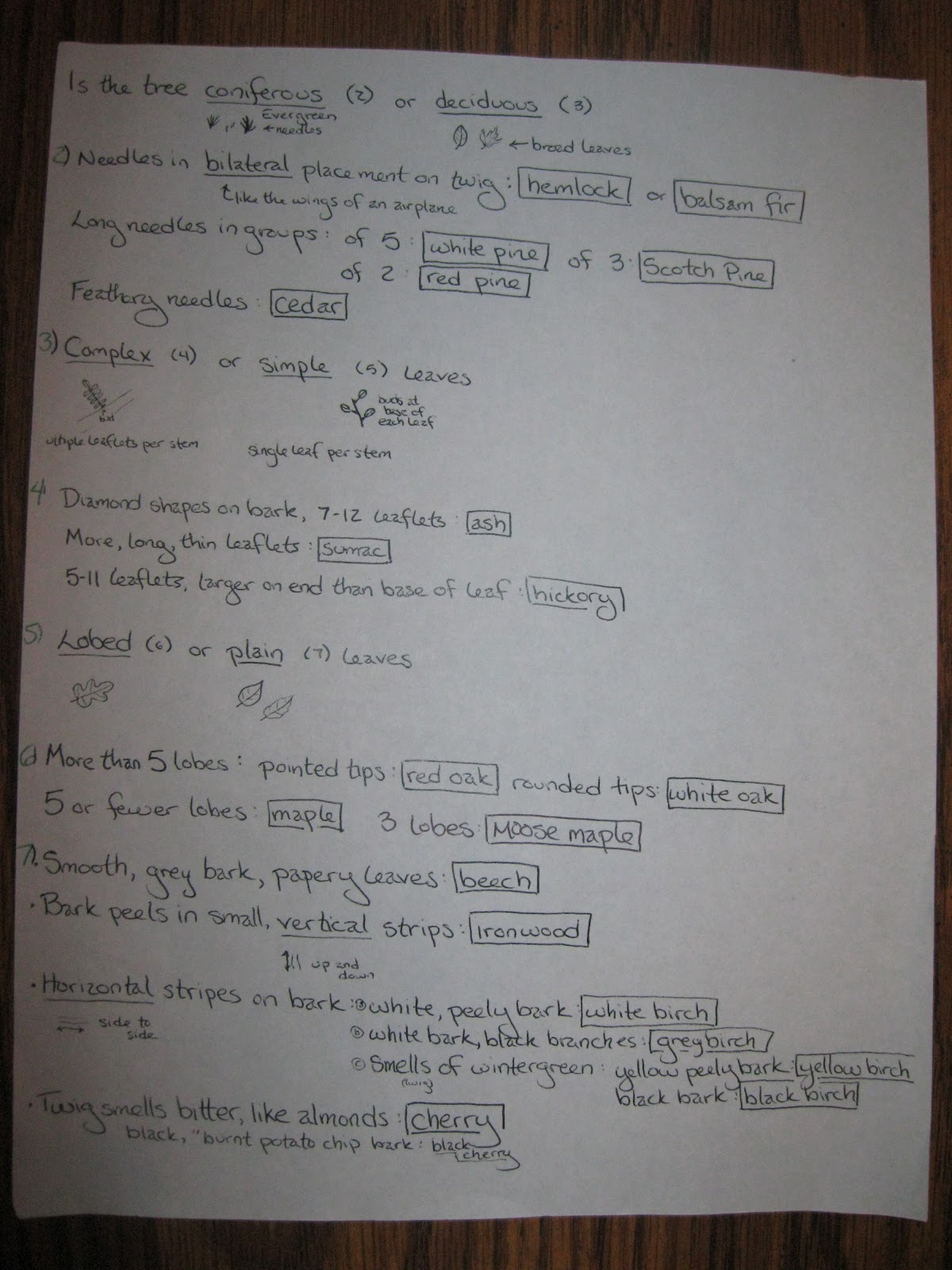
My new, improved dichotomous key. Now with more trees!

Identifying a moose (striped) maple with the dichotomous key.

The distinct striped bark and big, three-lobed leaves of the moose maple.

As when I was teaching camp in California, the kids' favorite game to play was a game teaching strategies animals might use in the wild to avoid being caught by predators (or to catch their prey.) These kids decided to call it "Snake Eye" since snakes rely on other senses besides sight, such as hearing and scent, since their eyes are not always very strong. In the game, one player is blindfolded and has to "catch" others trying to sneak up on them only using their hearing.

 Listening...

 Nope, not there...

 Ahh, that's the ticket!

 Listening...

 Sneaking...

Sneaking...

Contrary to the way this photo looks, it was actually taken 
moments before she caught him.

We played this game in various places so we could see how the terrain affected the strategies each person used. We also discussed real-world applications of these strategies for animals.

I got some great photos of the students demonstrating a principle during our astronomy lesson on the last day. We discussed how since the moon takes 28 days to rotate on its axis as well as 28 days to revolve around the Earth, the same side is always facing the Earth. As we watch the phases of the moon over a month, we are seeing one day happen on that side of the moon.

 The pillow is to show the side of the moon facing us is denser than the other

 Rotating and revolving, moon around Earth, Earth around sun.

 Switching up the roles to give everyone a turn. We were all very dizzy!

 Drawing our own constellations on a star map


Still a favorite of all the kids, I brought my pet baby corn snake for everyone to learn about and choose to touch or hold (or not.) Everyone in this group was really excited to hold Ned.

And now for the Ned glamour shots:


Today a girl said to me "This is the best week of my life!" (apparently not only because of nature camp, but because she gets to go to the drive-in movies over the weekend.) And that right there is what keeps me doing the work I do!

Saturday, June 30, 2012

Milton Camp

We had an amazing week! I ran a "From the Ground Up" program in Milton, and we learned and explored and played all over the park. As the name (and previous version of the program) suggests, we started out on the first day talking about soil, geology, and hydrology, worked up to plants and trees, then animals, then weather and astronomy. We looked at how each builds on the foundations provided by the other aspects of the natural world.

We climbed a few trees that blocked the trail

The tidbits that stuck with the children during this week made me smile. For example, after discussing soil layers the first day, all week any leaves were called O layer and any bare soil was the A layer. "Look Lisa, we're walking on the A layer!"

Someone dug this trench and so we were able to see soil layers!

This group's creativity astounded me. I taught them the vocab word "snag" (Remember? A favorite of the little lady's.) Then we reached a fork in the trail, I asked them to "hang a right," and they countered with "don't you mean snag a right?" And when I asked them not to touch something, like an animal that's just minding its own business, they said "Yeah, we should leaf it alone!"

They also liked to call the puddles we passed "frog mansions." I loved that. We spooked a frog into the water, and then found it under the mud. It was amazing, the frog stayed stock-still, even when we were pushing it through the water. It was firmly dedicated to pretending to be a rock. I hadn't seen that before!

They all loved to be able to identify and use jewelweed, because it's so useful if you get a cut, sting, or poison ivy exposure in the woods. Each of them was able to identify it by the end of the second day.

Rubbing jewelweed on a mosquito bite for relief

I had planned on spending most of the time outside, and then some weather happened. Thankfully we had some activities that were better suited to indoors, such as astronomy. I had a map of the stars visible in summer in Vermont for each of them. They used it to design their own constellations that they could actually find in the night sky!

After this activity, one of the girls drew her own star map
and asked ME to design constellations for it.

I also have a secret weapon for making rainy days run smoother, his name is Ned. 


Ned is my personal pet, I just got him this year (he's probably only two years old!) When I asked each of the kids what their favorite part of the week was, they each said, without hesitation, "Holding Ned!"

Another favorite activity was playing "Star-Nosed Mole." While we played a lot of games and activities this week, the kids asked to play a few rounds of this game every day! One girl really loved the game because she was "really into worms." I've never heard that one before, but, whatever floats your boat!

 Look at how smug that worm is, safe from the blind mole (as long as he's quiet!)

The group dynamic really affects the way a lesson goes. I always have a lesson plan, but I stay very fluid so if the kids show particular interests then that's what the lesson will become. For example, we spent a good chunk of time discussing wild edible foods. One of the kids even taught me that you can make a dessert out of the seed pods of timothy grass! We found a lot of wood sorrel, which looks like clovers only has heart-shaped leaves and tastes a bit lemony. We also saw a lot of strawberry plants (with no fruit yet) and blackberries!

The whole week was full of special discoveries and hypotheses:

We saw the difference between sapwood and heartwood as displayed 
where the sap leaked out of this white pine when it was cut. 

We smelled wintergreeny "sweet" (black) birch 

(and tasted it too!)

We saw this GIANT snail!

 (close-up)

Other good finds include a beaver stump near the swamp, some insects with unbelievable coloration, and many, many red efts!


Saturday, January 14, 2012

Nature Games 2

Another activity we'd do at camp was an "Around the World". I would have the students envision that the basketball court was a map of the world, and ask them to move around to different places where they might find certain things (Where they were born, where they would find an elephant, where they'd be in a desert, etc.) I loved seeing all the different answers! After the elephant question, the kids were in Asia, Africa, India, the LA Zoo...all across the globe :)

I liked this activity because it not only got the kids thinking about different places around the world, and gave opportunity to discuss different ecosystems they might not have learned a lot about, but it got them thinking spatially, about where places would be in relation to each other.

The game I saw children enjoying the most was a game showing different adaptations animals might use in the wild to get resources or avoid being caught by predators. We had a blindfolded student in the middle of the group, with an object, representing a resource, at their feet. During a round we'd point at students to approach the center and try to get the object without being detected. The blindfolded person had to point where they heard noise in order to get people out. The people had to return to their spots with the object in order to be successful. I saw so many different techniques. I saw distraction by throwing twigs in other places (even nearer other players in order to get them out) or when a player only moved when another player was making noise. We witnessed competition when several people reached the center and back to their original locations undetected, but since there was only one object, only one player was successful. We got to see techniques from the point of view of the sneaky prey and from the point of view of the keen predator. We got to discuss why an animal might not be able to use their sight to detect food or dangers. Honestly, watching how the kids reacted to the parameters of this game was super informative to me!

Tuesday, January 10, 2012

Nature Games 1

A friend asked for new ideas for her environmental education program. As I was reminiscing about a few projects and games I've done in the past, I realized I had never mentioned them on here. Considering what this blog was made for, that's a little bit of a major oversight on my part. Sometimes you don't think of your old stand-bys because, well, they're not news to you. So, a little time-travel magic and we'll talk about some of the games I pulled out at camp to fill in some time

I had a game that I adapted from a book of wildlife games. It was a big hit with the kids! It was sort of like "Sharks and Minnows", but with a twist. One child would be selected to be "it", this was the predator. The rest of the children were "prey". I had suggestions of everything from fox and rabbits to komodo dragon and water buffalo! The prey then had to run across the playing field, avoiding being caught (tagged) by the predator, to gather the food that was on the other side (we used balls to represent food.) They then had to return the food to their families waiting at home (the starting line.) There were a few safeties, hula hoops that represented bushes the prey could hide in. At the end of a round, any prey that was caught enabled the predator population to increase (a tagged "prey" child was an additional "predator" in the next round.) I found this worked best when each predator was only allowed one prey per round. Any predator that was not able to catch a prey in a round was returned to the "prey" side (representing a predator who died, and a subsequent increase in the prey population since they were able to get home safely with food and thus reproduce.)

After a few rounds this very neatly displayed the relationship between predator and prey population sizes. As the predator population rose, the prey population declined, forcing a decline in predator population, which allowed for a rise in the prey population and so on. By the end of the game, any of the children could describe this relationship to you, based solely on their observations. Plus they kept begging me for more rounds after I said time was up :)

Sunday, November 13, 2011

Summer Camp Tricks 3

Continued from Summer Camp Tricks 1 and 2


Discovery

Children learn best when they don't realize they're being taught. Lead them right up to the conclusion, talk them all the way around it, but get them to pronounce it in their own words before you're done. 

One of my jobs at camp was to mentor high-schoolers who wish to work with children in the future. I let them run some of the projects I had designed for the kids. Once I explained it to them I tried to give them slack reigns so I could see how they would choose to run the lesson. One common hang-up that I noticed was when they presented the activity to the children, they would give all the information at once, including the overall concept the activity was designed to teach. "By the end of this lesson you kids will be able to see..." I had to work on this with many of my high-schoolers. Just telling them once that this is not the best way to present the activity wasn't enough, they would continue to do their introductions this way. Possibly because this is the way I presented the activities to them. "See, this teaches the students [such] in [such and such a] way." I couldn't show them or tell them how to teach, they needed to learn to teach just as much as the students needed to learn.


Watching my high schoolers I really noticed the trap, and how easy it is to fall in: we can't get caught in the idea that we're giving students information. We all know we are super smart, but the kids will respond better and retain more if they learn to draw the conclusions themselves. If they feel empowered, it is something they will remember.

Saturday, October 22, 2011

Summer Camp Tricks 2

Continued from Summer Camp Tricks 1


Diversion!

As we went along our nature walks, we devised a 'telephone'-esque system for passing back safety information on the trail. I made sure each child pointed to the hazard as they told the message to the person directly behind them. This way they not only kept each other safe on the trail, they also learned what hazards look like. By the end of each hike, most of the kids could identify poison oak on their own. But they didn't really notice this exercise in respect, team building, and plant identification. They were busy having fun with it. It is so cute to listen to a whole line of 7-year-olds walking behind you chirping "poison oak, poison oak", and "look, it's right there!". Even better when within a few yards of each other we saw both the poisonous vine and some presents left behind by the horses in the camp stable. Then you could really see how akin to the game our system was. By the end of the line, my children were warning each other against the "poisonous horse scat"!

Poison what?!?!

Some of the kids were not super excited to have to exercise and deal with insects as we do on a hike, but this gave them a little something extra to put their minds to, they had less chance to get bogged down in complaints. And it made my job easier, rather than having to work to get attention to warn an entire group about every hazard along the way, I just had to point and listen to the ripples.

Thursday, October 6, 2011

Summer Camp Tricks 1


In posts I have discussed how I attempt to incorporate a little information into everyday outdoor play without making it seem like a lesson. However, being a nature professional with the teaching bug, I find myself IN lessons, the likes of which children don't always wish to attend. At camp I would get feedback such as "the nature program is like school" because of the lessons tacked onto my hikes and games. So how do I disguise a lesson from the children?

Animation is one of the best tools of course, but one you have to find for yourself, on your third nature hike of the day, in 95 degree weather, with enough leftover energy to convince the kids who don't want to go, and the counselors who don't want to go...wait, where was I? Oh yes...

Tools in my knapsack include:
1) Exaggeration
2) Diversion
3) Discovery

Exaggeration

On our nature hikes at camp, it was important to me that the kids understood why what we did was for safety. I had the children tell me why such things as "stay on the trail" and "use your walking feet" were important, I described how we would act on the hiking trail, and warned them about potential trail hazards. The kids would come to Nature all pumped to go on a hike (or perhaps not, in which case I would pump them up for it) and have to sit and listen to safety instructions?!?! I had some glazed eyes. In this instance I pulled out exaggeration.

"On the trail, I will stay in the front because I know where we are going and I'll be on the lookout for hazards such as poison oak and rattlesnakes (not an exaggeration, we were in southern California after all.) Your counselor will take up the caboose, in case any mountain lions sneak up on us. They'll distract it so the rest of us have time to get away." Jaw-open stares, the kids who had stopped paying attention snapped to. Is she being for real? But when all the counselors and myself burst out laughing the kids joined in. Yes I guess it was POSSIBLE to see a mountain lion, but not probable (and we would work hard to keep the kids safe of course).

This established with the children that we were going to have fun. It's ok to joke around: we could play while we walk and talk. Yes I'd be telling them things they need to know, but it wouldn't be all shop talk.

One does need to be careful here though. For example, occasionally a kid would express worry that we were going to get lost. When I reassured them that I knew the trails, sometimes I tagged on a "have I ever steered you wrong before?" I realized at that moment how important it is that they never have a reason to doubt this, and even a joke could have an impact on an impressionable child. Thankfully they always answered no. The children need to be aware of a difference between a joke and a deficit in credibility.

Sunday, September 18, 2011

I Hate Nature

This summer I led a nature program at a camp in southern California. Among other activities I would lead several nature walks every day, each time with a new group of kids. These kids mostly grew up in Los Angeles county and some were unenthused, if not downright scared, by exploring nature.

To me, one of the most cringe-worthy statements that leaves a child's mouth is "I hate _______". Be it snakes, spiders, dirt, mud, etc. Let me tell you, I heard it a lot at camp. Children tend to be pretty quick to judge what they don't understand,. The good news is, they are quick to turn around as well. This statement creates a teachable moment, and a little bit of information can go a long way here.

Before leaving on these walks I would briefly address the fact that everything in nature is connected in ways we don't always see at first glance. On the walk it was pretty typical to hear many complaints about flies buzzing near their ears. Then, inevitably, we would run into a spider. The reactions varied: some children were petrified, others disgusted, one or two wanted to step on it or get me to. I would first remind the children that the spider is outside, we are in its home, so we should leave it alone. Besides, this type of spider is harmless to humans. In fact, it is on our team: it is working hard to get rid of those pesky flies. You can take it a step farther and say that spiders are food for birds, so we need them to have beautiful birds around. The kids I talked to generally knew these things from class, but had never connected it to the actual world around them

It is easy to get people in general to care about what we call "charismatic megafauna" (basically, if it's cute and looks cuddly.) It is more difficult to work on the rest, especially if we ourselves are not very comfortable with the animal in question. No matter what we think of it though, it's important to instill in our children the respect for life.