Showing posts with label Kids. Show all posts

Monday, July 21, 2014

New "Simple" Dichotomous Key

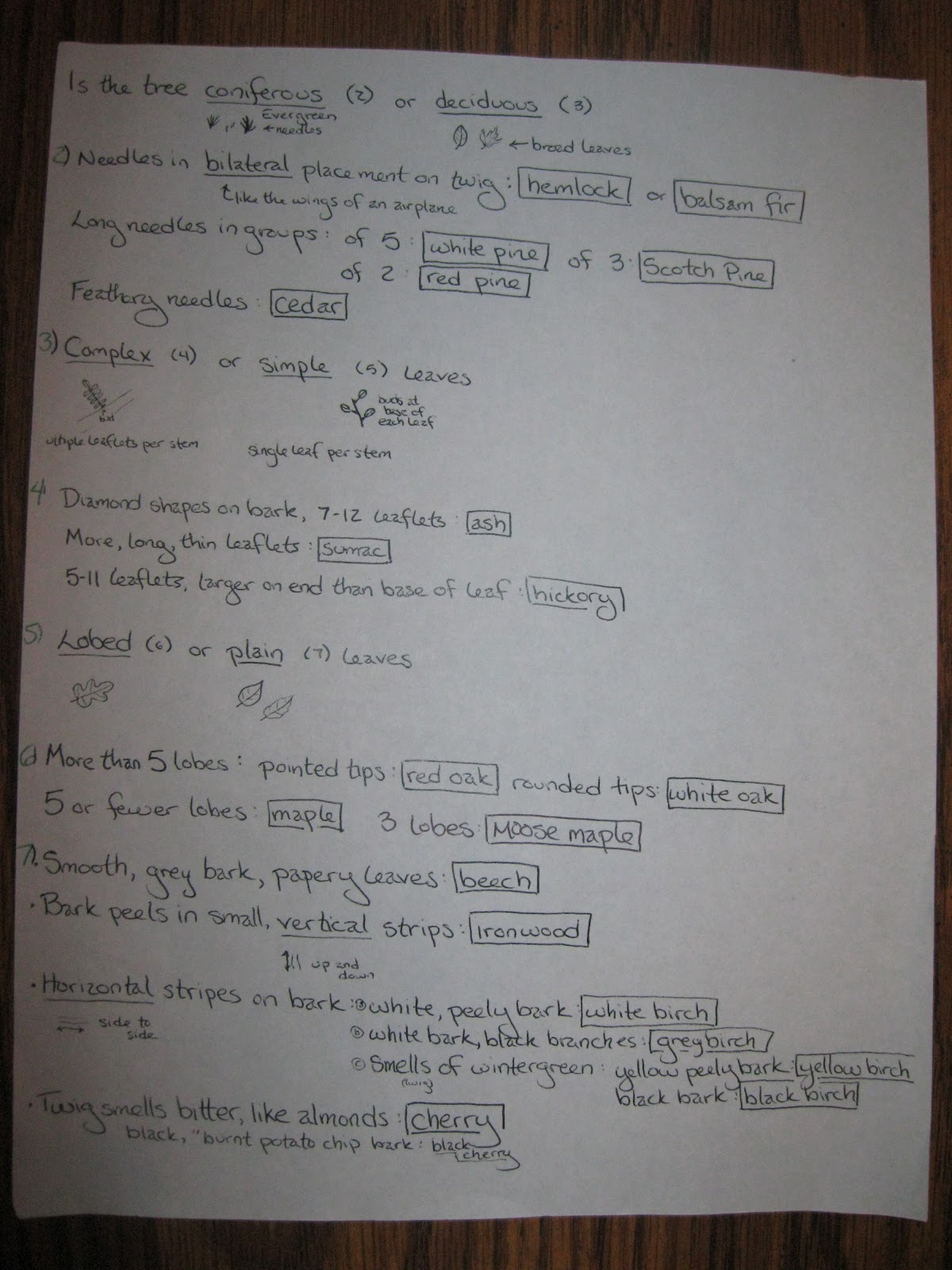
I made a new, improved simple key for tree identification. It's geared to narrow down some of the common types of trees in Vermont, in a simple, kid-friendly way. Print off a copy, try it out, and let me know what you think! If you have trouble with it, let me know and I can help you out.


Then, once you get good at using the simple dichotomous key, you can continue to improve you tree identification skills with a more detailed key. There are many available in book form and online, I would suggest trying a few out to see what style works best for you.

Happy identifying!
~Lisa

Sunday, April 14, 2013

Hypotheses

Today we biked to a little natural area by the Winooski River, and then let the Little Lady run about to see what she could discover. This is my favorite part, when we let the scientific discoveries come naturally! We wound up discovering many things we couldn't explain right away, so we had to use our powers of observation to form and test hypotheses. For the record, the way the Little Lady defined a hypothesis is an "educated guess", so that means it is based on the information we found, rather than just an off-the-cuff guess.

The first thing we found was some beaver damage on a tree. We made the educated guess that it was beaver damage since we were next to a river and we happen to know beavers live nearby. The beaver hadn't felled the tree, but just nibbled on it. The beaver might have done this to get a snack. They only eat the layer of a tree just beneath the bark (the cambium), not the main wood. Another reason for gnawing this tree might have been to file their teeth. Beavers teeth never stop growing, like our fingernails, but they don't have nail clippers!

Other animals create similar damage. This picture is actually porcupine damage.
(I didn't have my camera today, so I'm using this picture I took earlier.)


We also found some fire damage. The Little Lady was concerned about our hypotheses for this, because "hypotheses must be testable." She's right of course, but we discussed how you can test a hypothesis through research, rather than experimentation. One way to do this would be to ask the people who manage the natural area. However, while we were there we used our powers of observation to see if we could make our hypothesis stronger, or disprove particular ideas. For example: since we didn't find a lightning strike, we don't think it was naturally caused. It might have been a controlled burn by people who are experts in that field.

The biggest part of the adventure was spent studying water current in the river. It was a completely self-designed experiment by the Little Lady herself. She threw a stick and a hollow reed into the river to try to see if the hollow one would get waterlogged and sink faster. They were swept downstream too quickly to tell that time, but then something else happened. She threw a tiny piece of reed very close to the bank, and it started moving backward! Lucky we had a friend with us today who is an experienced canoe paddler. He told us about how directly downstream from a point where something, like a rock or log, juts into the river, the steam will create an eddy behind the point. In an eddy the water moves upstream because of the faster water moving in the main stream channel. This difference in current means that sometimes at the edge of an eddy you can see tiny whirlpools.

Image borrowed from the New York State Department of Environmental Conservation website

We saw waterfowl in the river; a pair of Canada geese and two pairs of black ducks. We also heard birds. The Little Lady identified the crow call. I tried to point out the red-winged blackbird call, but there was also a black-and-white warbler calling, and she kept thinking I was referring to their squeeky-wheel sounding call. We also heard a mourning dove. I'll have to come up with a better system for incorporating bird calls into my lessons now that I'm getting better at them (I've been practicing!)

The best part of today, for me, is that I had no plan for this outing, I was just thinking a quick bike ride to the end of the road and back. You really never know what you're going to find to learn from when you walk out your front door! That's the amazing part about working with kids in nature: you can quite literally never run out of new things to learn about. Who knows what the next post will explore!

Friday, August 3, 2012

Colchester Camp

This week I ran a "From the Ground Up" program in Colchester. The themes were similar to the one I ran in Milton last month, but this program was different based on the places we were able to hike, the particular interests of the kids involved, and the things we saw. For example, in this camp we discussed some orienteering and even measured our individual pace length for measuring distances in the woods.

On our way out of the woods we found some hula hoops abandoned on the playground

We spent the first two days at one site, talking about soil, groundwater, bedrock, plants, trees, some animals, and (of course) playing games. Then the third and fourth days we were at a second site where we had access to a different type of forest as well as a tiny part of Colchester bog (I posed about this site before, read about it here.) We saw several carnivorous pitcher plants, as well as cotton grass and peat moss, plants very specific to bog environments. We also found a plant we all recognized very easily. I painstakingly identified, and was the first to eat and confirm, wild blueberries! Once we were sure, we all got to chow down. There were other berries around, so we were all careful to notice the difference and only pick the right ones.

Picking blueberries

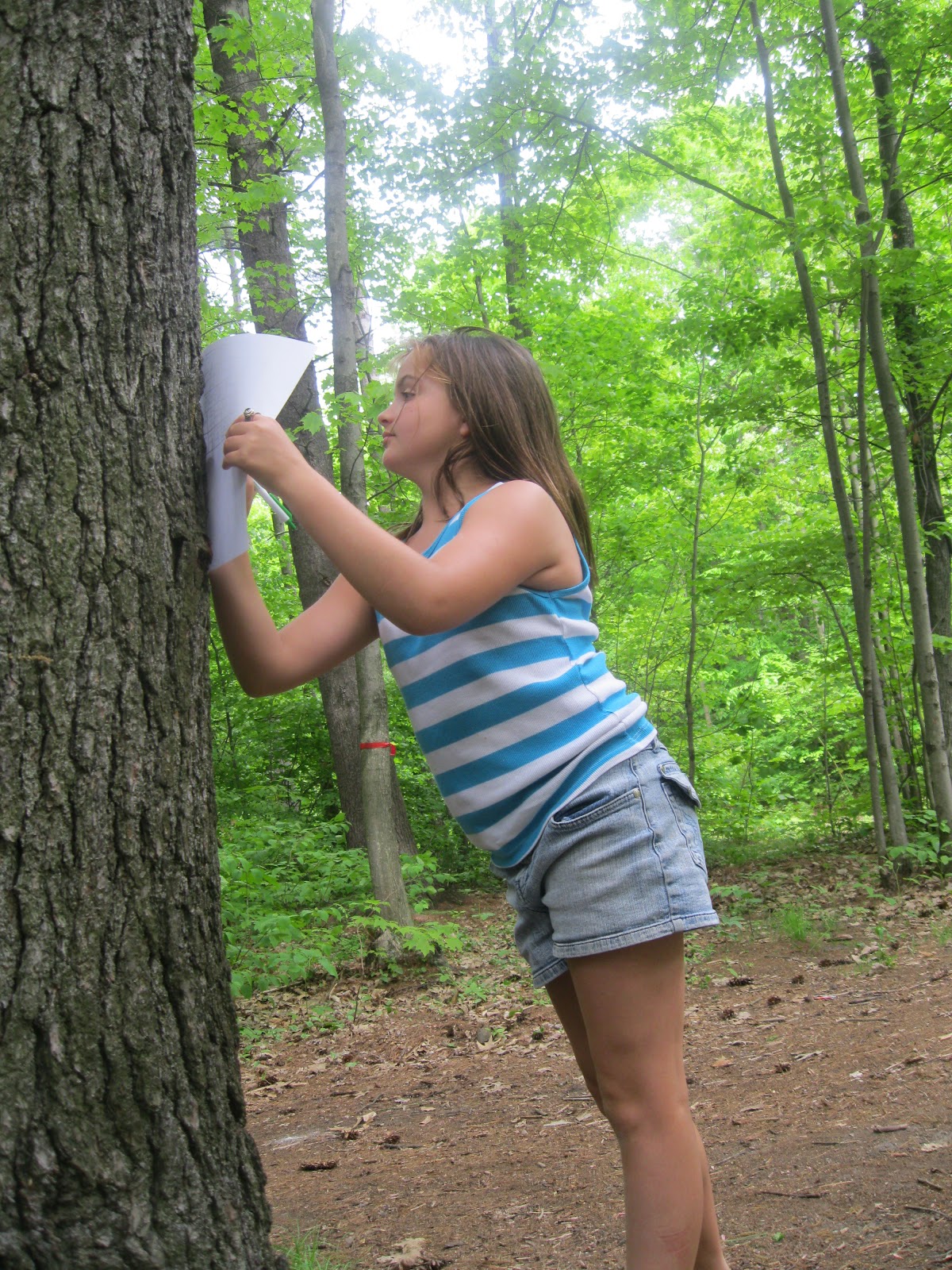
These children really picked up on tree identification, which I appreciated because it's one of my favorite parts to talk about. After only one day teaching different types of trees, the next day they came in pointing out ones they remembered. "Look, there's a white pine. And that one's a hemlock!" I barely had to use the dichotomous key with them. But I wanted them to see how to use one, and they really found it interesting.

My new, improved dichotomous key. Now with more trees!

Identifying a moose (striped) maple with the dichotomous key.

The distinct striped bark and big, three-lobed leaves of the moose maple.

As when I was teaching camp in California, the kids' favorite game to play was a game teaching strategies animals might use in the wild to avoid being caught by predators (or to catch their prey.) These kids decided to call it "Snake Eye" since snakes rely on other senses besides sight, such as hearing and scent, since their eyes are not always very strong. In the game, one player is blindfolded and has to "catch" others trying to sneak up on them only using their hearing.

 Listening...

 Nope, not there...

 Ahh, that's the ticket!

 Listening...

 Sneaking...

Sneaking...

Contrary to the way this photo looks, it was actually taken 
moments before she caught him.

We played this game in various places so we could see how the terrain affected the strategies each person used. We also discussed real-world applications of these strategies for animals.

I got some great photos of the students demonstrating a principle during our astronomy lesson on the last day. We discussed how since the moon takes 28 days to rotate on its axis as well as 28 days to revolve around the Earth, the same side is always facing the Earth. As we watch the phases of the moon over a month, we are seeing one day happen on that side of the moon.

 The pillow is to show the side of the moon facing us is denser than the other

 Rotating and revolving, moon around Earth, Earth around sun.

 Switching up the roles to give everyone a turn. We were all very dizzy!

 Drawing our own constellations on a star map


Still a favorite of all the kids, I brought my pet baby corn snake for everyone to learn about and choose to touch or hold (or not.) Everyone in this group was really excited to hold Ned.

And now for the Ned glamour shots:


Today a girl said to me "This is the best week of my life!" (apparently not only because of nature camp, but because she gets to go to the drive-in movies over the weekend.) And that right there is what keeps me doing the work I do!

Saturday, June 30, 2012

Milton Camp

We had an amazing week! I ran a "From the Ground Up" program in Milton, and we learned and explored and played all over the park. As the name (and previous version of the program) suggests, we started out on the first day talking about soil, geology, and hydrology, worked up to plants and trees, then animals, then weather and astronomy. We looked at how each builds on the foundations provided by the other aspects of the natural world.

We climbed a few trees that blocked the trail

The tidbits that stuck with the children during this week made me smile. For example, after discussing soil layers the first day, all week any leaves were called O layer and any bare soil was the A layer. "Look Lisa, we're walking on the A layer!"

Someone dug this trench and so we were able to see soil layers!

This group's creativity astounded me. I taught them the vocab word "snag" (Remember? A favorite of the little lady's.) Then we reached a fork in the trail, I asked them to "hang a right," and they countered with "don't you mean snag a right?" And when I asked them not to touch something, like an animal that's just minding its own business, they said "Yeah, we should leaf it alone!"

They also liked to call the puddles we passed "frog mansions." I loved that. We spooked a frog into the water, and then found it under the mud. It was amazing, the frog stayed stock-still, even when we were pushing it through the water. It was firmly dedicated to pretending to be a rock. I hadn't seen that before!

They all loved to be able to identify and use jewelweed, because it's so useful if you get a cut, sting, or poison ivy exposure in the woods. Each of them was able to identify it by the end of the second day.

Rubbing jewelweed on a mosquito bite for relief

I had planned on spending most of the time outside, and then some weather happened. Thankfully we had some activities that were better suited to indoors, such as astronomy. I had a map of the stars visible in summer in Vermont for each of them. They used it to design their own constellations that they could actually find in the night sky!

After this activity, one of the girls drew her own star map
and asked ME to design constellations for it.

I also have a secret weapon for making rainy days run smoother, his name is Ned. 


Ned is my personal pet, I just got him this year (he's probably only two years old!) When I asked each of the kids what their favorite part of the week was, they each said, without hesitation, "Holding Ned!"

Another favorite activity was playing "Star-Nosed Mole." While we played a lot of games and activities this week, the kids asked to play a few rounds of this game every day! One girl really loved the game because she was "really into worms." I've never heard that one before, but, whatever floats your boat!

 Look at how smug that worm is, safe from the blind mole (as long as he's quiet!)

The group dynamic really affects the way a lesson goes. I always have a lesson plan, but I stay very fluid so if the kids show particular interests then that's what the lesson will become. For example, we spent a good chunk of time discussing wild edible foods. One of the kids even taught me that you can make a dessert out of the seed pods of timothy grass! We found a lot of wood sorrel, which looks like clovers only has heart-shaped leaves and tastes a bit lemony. We also saw a lot of strawberry plants (with no fruit yet) and blackberries!

The whole week was full of special discoveries and hypotheses:

We saw the difference between sapwood and heartwood as displayed 
where the sap leaked out of this white pine when it was cut. 

We smelled wintergreeny "sweet" (black) birch 

(and tasted it too!)

We saw this GIANT snail!

 (close-up)

Other good finds include a beaver stump near the swamp, some insects with unbelievable coloration, and many, many red efts!


Sunday, June 17, 2012

Ticks!

I've been hearing a lot of concern about ticks recently; from parents, from my friends, from the inside of my own head...Tick bites are definitely something to be concerned about, but as long as they are properly dealt with nobody should have any reason to worry. I've had plenty of 'em, and have never suffered any ill effects (aside from the gross-out factor.) Tick worry should never keep you and your children from adventuring, you just need to know how to deal with them. So, here's how.

Step One. Actually the only step I'll list. It is the best, easiest, and most important step, the rest are just details. Every time you are outside, check yourself for ticks at the end of the day. Every time. I cannot stress this enough, catching a tick bite early is the best way to prevent any ill effects (more on this later.) A tick can be tiny, so even look for something that could just look like a new freckle. Check your whole body, use a mirror for your back, especially check the base of the neck, hairline, and armpits. I have seen a lot of bites right along the waistline of pants (especially near the bellybutton.) Change your clothes once you get inside, and check them to make sure you're not bringing ticks inside on them. Another good piece of advice one of my outdoorsy friends told me recently: "In summer I switch from taking a morning shower to a night-time shower, just to be sure."

What you're looking for.
Only the top one can carry Lyme disease, but you could see any of these around here.

If you catch a tick before it has bitten you, you have to be sure to get rid of it properly. Now, normally I am the type of person who will go out of their way to bring an insect or spider outdoors instead of using my shoe, but things like ticks and mosquitoes are my exception. They made it personal. When you are trying to be rid of a tick, make sure to crush them (they are much harder to successfully squish than other insects.) Dispose of the bodies in an outdoor trash or flush them down the toilet, you want to be sure they're gone.

If you have a bite, make sure to remove the tick by the part that is closest to your skin (you don't want to squeeze the tick's body while it's still biting you, this creates more risk of infection.) Put the tick in some rubbing alcohol to kill it and take a look at it. Take a picture if you want, so you can tell what type of tick it was. Ultimately though, if you present symptoms a doctor would test you and not the tick, so you can get rid of it. Back to your wound, be sure to check and make sure you didn't leave behind the tick's head, nobody wants that. It would look like a little black speck in the bite area, or a headless tick in your pool of alcohol. For the record, it might be tricky to get all the mouthparts out, but this should not increase your risk of infection. Just do your best. 

Here's what people really need to know about tick bites: am I going to get sick? Most people who get bitten do not! Not all ticks carry Lyme diease. Only the blacklegged (or "deer") tick does, and they have to have bitten an infected creature before they bite you in order to be a carrier. The biggest reason not to panic about Lyme disease is timing. If you do a tick check after every time you are outside then the bite cannot have been there very long. If a tick has been implanted on you less than 24 hours then there is a very low chance that they can give you the disease, even if they have it.

What you need to do is watch the bite area, one of the first symptoms is a bulls-eye type rash around the area. Sometimes this rash doesn't happen, so if you go to your doctor with flu-like symptoms and a stiff neck within a few weeks of a tick bite, be sure to tell them about the bite. If you do have Lyme disease and catch it early, it's just like any other type of bacterial infection. It is not fun, but antibiotics clear it right up. Again, some of my friends have been treated for Lyme disease, and they're outside right now none the worse for the wear.

If you have any more questions about ticks, be sure to shoot them my way. Or the website for the Vermont Department of Health has some very excellent information, you can find it here.


Tuesday, May 29, 2012

Memorial Day Weekend Butterflies

This weekend was just chock full of wild animal and plant encounters. The first of which was Saturday, when we got to spend time with a friend of mine who is a lepidoptery (butterfly and moth) fanatic. We pulled out our butterfly nets:


And got lucky!

That's him! My lepidopterist friend :)

We caught more butterflies in the sunlight as opposed to the shade, and near flowers especially. They are trickier than they look, we saw many more butterflies than we were able to catch. My favorite was the spring azure, which is tiny and baby blue in color.

Here are some pictures of a tiger swallowtail we caught. Note that my friend, as a lepidopterist's daughter, has been trained in how to hold butterflies without hurting them. No butterflies were harmed in the making of this post!


 See the lovely tail and stripes on each wing! If you look closely you
can see its long tongue (proboscis) is curled near its head

When we let the butterfly go it flew off really quickly and very high in the air. Looking at how it flies, we're lucky we caught it at all!

Friday, May 25, 2012

After School: Animals

In our "From the Ground Up" after school program, we've talked about 1) the soil and how it lays foundation for plants, 2) the plants themselves, and now 3) we're talking about what the plants do for animals and vice-versa.

We saw standing dead trees ("snags") and discussed how they provide different habitat for animals than fallen dead trees (for example, birds make their homes in cavities on snags.) 

We talked about detritus (matter that is no longer living) and the organisms that break that down. This really shows that worms and fungi are crucial to our ecosystems, because otherwise the nutrients locked away in detritus wouldn't be made available for new plants.

We looked for wildlife signs (and frogs) in this stream.

We identified some mast trees (trees that produce food for animals, such as white pine cones or beech nuts.) And once we did this, we had pretty much all the vocabulary to play the wildlife BINGO game I designed for just this occasion!

Looking for items on their cards

We did have to discuss what "invertebrate" meant, and what examples of behavior we saw count as defense mechanisms. Which was perfect because the point of this activity was to raise questions and creative ideas. For example, the little lady used herself to fill the categories of omnivore, two-legged animal, and mammal. 

She asked for a hard surface to write on,
I told her where to find one.

At one point the little lady pointed at me and said "I see a two-legged mammal right there!" At which her friend pointed at both of us, saying "I see two!" Our third friend, who had wandered off a bit looking for snags, called back "I see three, and they're laughing like crazy people!"

As we walked back to the school all three of the girls looked for a black birch tree so they could chew on the end of a twig and taste the sweet wintergreen like we did last week.

Monday, May 21, 2012

Local Motion Hike

On Saturday I led a family nature walk with Local Motion at Ethan Allen Park in Burlington, VT. Three lovely families joined us, with their five charming children. I knew I was with a great group when right off one little boy pointed at a Norway maple tree and said "Maple!" He later showed me that he knows oak as well, while looking at a dried leaf on the path.

Maple! 

First off we rolled over a log and found a spider, a worm, and a millipede. We also found and identified some poison ivy before we left the path, so everyone would know what not to touch. There aren't many things in Vermont woods that will hurt you, we are very lucky in that regard!

Examining a millipede

Right next to the poison ivy we found a sprig of jewelweed. This plant is so very useful, the juices in its leaves can even help poison ivy rashes, so you don't have to wait till you get home to start treating it if you're exposed. In my observation jewelweed tends to grow near the plants that cause the harm they can fix, like poison ivy and nettles. Nature is pretty amazing like that!

Pale jewelweed (old photo, it is not in bloom yet this time of year.)

Along the hike we looked at acorn caps from oak trees, and saw a squirrel that might be responsible for eating the acorn out of the cap. We went on a mini scavenger hunt and collected lots of dandelions. We also planted many dandelion seeds with our personal wind power!

Scavenger hunt and dandelion picking in a field

At a very exciting moment in the day, I spotted and caught a toad in the woods. Everyone got a chance to touch it with one finger.

Toad!

Then we finally made it up to the tower, I was so proud of how all those tiny legs walked the whole way. We had a nice rest and enjoyed the view before heading back down.

If you are interested, I have another post on a hike in Ethan Allen Park, with tower photos, that you can read here. I also talk more about jewelweed in a post from a hike up Mount Philo last fall, that post is here.