Tuesday, July 10, 2012

Bat Rescue

I found myself in a unique situation recently: driving down the highway in 90 degree weather with no air conditioning and a bat in a box on the floor of my passenger side.

As a precursor to this story: I have training in how to deal with bats, I worked with them through the Vermont Fish and Wildlife department. Bats have a high risk of carrying rabies, which is very dangerous to humans. This is one of those "do not try at home" situations. If you come in contact with a bat, do not let anyone handle it*.

Now, back to the story.

We had found the bat baking in the sun on the pavement on our way back from lunch. I could tell from a glance that it was severely dehydrated, based on the appearance of the membrane on its wings. The first important step in any such situation is to protect yourself. We happened to be near some campus medical buildings, so I grabbed a few pairs of nitrile gloves. Being careful not to touch the bat directly, even with the gloves, I coaxed it onto a piece of cardboard and moved it out of the sun. Then, when I dribbled a small puddle of water near the bat's face, we got to see it quickly start lapping up the water like a very, very small kitten.

I made a few phone calls and found a veterinarian that deals with wildlife. That brings us back to where we started; transporting Bartleby to the vet. I named the bat Bartleby, even though I am still not 100% sure he is male. It just seemed to suit 'him'.


When I arrived one of the first questions the vet asked was about the risk of rabies exposure. I was proud to be able to tell him that nobody had direct contact with Bartleby since I became responsible for it, not even me! This made things a lot easier, and a lot safer for Bartleby since they didn't have to worry that he was spreading diseases.

They say that bats don't always respond very well to rehabilitation, but we gave it our best shot! The vet started by feeding him a sugar, vitamin, and water solution to help with the starvation and dehydration.

 Bartleby lapped it right up, must have been delicious...to a starving bat

Then they offered Bartleby some mealworms and crickets, which he refused. We figured part of the problem there might have been stress from so much human exposure. Sure enough, the vet left him alone overnight and he ate in the morning. I had to leave, but I knew I was leaving Bartleby in excellent hands.

The vet had his rabies shots, but this towel helped him not risk it while handling Bartleby.

In recent times bat populations have been in trouble, largely due to the white nose fungus but also to some unknown complications. Researchers are working to gather information on these secondary problems. Bartleby did not exhibit signs of whitenose. If we can figure out why Bartleby was struggling, we might understand better how to help the bat populations overall.


*In you find yourself in contact with a wild animal, you can contact the Vermont Fish and Wildlife Department at (802) 241-3700, and they may be able to give you instruction on how to deal with your wildlife situation.

Saturday, June 30, 2012

Milton Camp

We had an amazing week! I ran a "From the Ground Up" program in Milton, and we learned and explored and played all over the park. As the name (and previous version of the program) suggests, we started out on the first day talking about soil, geology, and hydrology, worked up to plants and trees, then animals, then weather and astronomy. We looked at how each builds on the foundations provided by the other aspects of the natural world.

We climbed a few trees that blocked the trail

The tidbits that stuck with the children during this week made me smile. For example, after discussing soil layers the first day, all week any leaves were called O layer and any bare soil was the A layer. "Look Lisa, we're walking on the A layer!"

Someone dug this trench and so we were able to see soil layers!

This group's creativity astounded me. I taught them the vocab word "snag" (Remember? A favorite of the little lady's.) Then we reached a fork in the trail, I asked them to "hang a right," and they countered with "don't you mean snag a right?" And when I asked them not to touch something, like an animal that's just minding its own business, they said "Yeah, we should leaf it alone!"

They also liked to call the puddles we passed "frog mansions." I loved that. We spooked a frog into the water, and then found it under the mud. It was amazing, the frog stayed stock-still, even when we were pushing it through the water. It was firmly dedicated to pretending to be a rock. I hadn't seen that before!

They all loved to be able to identify and use jewelweed, because it's so useful if you get a cut, sting, or poison ivy exposure in the woods. Each of them was able to identify it by the end of the second day.

Rubbing jewelweed on a mosquito bite for relief

I had planned on spending most of the time outside, and then some weather happened. Thankfully we had some activities that were better suited to indoors, such as astronomy. I had a map of the stars visible in summer in Vermont for each of them. They used it to design their own constellations that they could actually find in the night sky!

After this activity, one of the girls drew her own star map
and asked ME to design constellations for it.

I also have a secret weapon for making rainy days run smoother, his name is Ned. 


Ned is my personal pet, I just got him this year (he's probably only two years old!) When I asked each of the kids what their favorite part of the week was, they each said, without hesitation, "Holding Ned!"

Another favorite activity was playing "Star-Nosed Mole." While we played a lot of games and activities this week, the kids asked to play a few rounds of this game every day! One girl really loved the game because she was "really into worms." I've never heard that one before, but, whatever floats your boat!

 Look at how smug that worm is, safe from the blind mole (as long as he's quiet!)

The group dynamic really affects the way a lesson goes. I always have a lesson plan, but I stay very fluid so if the kids show particular interests then that's what the lesson will become. For example, we spent a good chunk of time discussing wild edible foods. One of the kids even taught me that you can make a dessert out of the seed pods of timothy grass! We found a lot of wood sorrel, which looks like clovers only has heart-shaped leaves and tastes a bit lemony. We also saw a lot of strawberry plants (with no fruit yet) and blackberries!

The whole week was full of special discoveries and hypotheses:

We saw the difference between sapwood and heartwood as displayed 
where the sap leaked out of this white pine when it was cut. 

We smelled wintergreeny "sweet" (black) birch 

(and tasted it too!)

We saw this GIANT snail!

 (close-up)

Other good finds include a beaver stump near the swamp, some insects with unbelievable coloration, and many, many red efts!


Saturday, June 23, 2012

Milton Reconnaissance

The other day my friend (author of Lunches Fit For a Kid) came with me to investigate the trails at the park in Milton, so that I'll know where to go during my summer camp next week. It is a very interesting place,  and you'll see much more of it in the coming week I'm sure. Lots of different trees to talk about, ferns galore, and even some wildlife :)

Like this guy

We saw a few different American Toads (like that guy.) Common misconception: toads ARE frogs. We like to make the distinction that toads are more terrestrial, and they have drier, bumpy skin, but there is no difference according to the scientific family tree. They also don't have warts: their skin is supposed to be like that. The bumpiness helps break up their outline, so it's camouflage!

That bump behind its eye is a gland, not a wart.

While you can't get warts from touching toads, their sensitive skin can be harmed by your hands! I make it a point to never handle amphibians if I have sunblock or insect repellent or other harsh, chemical substances on my hands. The substances would enter their body easily through their super-absorptive skin and that would not make a happy little critter.

No toads were harmed in the making of this post. I've been trained in how to hold them, and I let him go right back where I found him :)


Sunday, June 17, 2012

Ticks!

I've been hearing a lot of concern about ticks recently; from parents, from my friends, from the inside of my own head...Tick bites are definitely something to be concerned about, but as long as they are properly dealt with nobody should have any reason to worry. I've had plenty of 'em, and have never suffered any ill effects (aside from the gross-out factor.) Tick worry should never keep you and your children from adventuring, you just need to know how to deal with them. So, here's how.

Step One. Actually the only step I'll list. It is the best, easiest, and most important step, the rest are just details. Every time you are outside, check yourself for ticks at the end of the day. Every time. I cannot stress this enough, catching a tick bite early is the best way to prevent any ill effects (more on this later.) A tick can be tiny, so even look for something that could just look like a new freckle. Check your whole body, use a mirror for your back, especially check the base of the neck, hairline, and armpits. I have seen a lot of bites right along the waistline of pants (especially near the bellybutton.) Change your clothes once you get inside, and check them to make sure you're not bringing ticks inside on them. Another good piece of advice one of my outdoorsy friends told me recently: "In summer I switch from taking a morning shower to a night-time shower, just to be sure."

What you're looking for.
Only the top one can carry Lyme disease, but you could see any of these around here.

If you catch a tick before it has bitten you, you have to be sure to get rid of it properly. Now, normally I am the type of person who will go out of their way to bring an insect or spider outdoors instead of using my shoe, but things like ticks and mosquitoes are my exception. They made it personal. When you are trying to be rid of a tick, make sure to crush them (they are much harder to successfully squish than other insects.) Dispose of the bodies in an outdoor trash or flush them down the toilet, you want to be sure they're gone.

If you have a bite, make sure to remove the tick by the part that is closest to your skin (you don't want to squeeze the tick's body while it's still biting you, this creates more risk of infection.) Put the tick in some rubbing alcohol to kill it and take a look at it. Take a picture if you want, so you can tell what type of tick it was. Ultimately though, if you present symptoms a doctor would test you and not the tick, so you can get rid of it. Back to your wound, be sure to check and make sure you didn't leave behind the tick's head, nobody wants that. It would look like a little black speck in the bite area, or a headless tick in your pool of alcohol. For the record, it might be tricky to get all the mouthparts out, but this should not increase your risk of infection. Just do your best. 

Here's what people really need to know about tick bites: am I going to get sick? Most people who get bitten do not! Not all ticks carry Lyme diease. Only the blacklegged (or "deer") tick does, and they have to have bitten an infected creature before they bite you in order to be a carrier. The biggest reason not to panic about Lyme disease is timing. If you do a tick check after every time you are outside then the bite cannot have been there very long. If a tick has been implanted on you less than 24 hours then there is a very low chance that they can give you the disease, even if they have it.

What you need to do is watch the bite area, one of the first symptoms is a bulls-eye type rash around the area. Sometimes this rash doesn't happen, so if you go to your doctor with flu-like symptoms and a stiff neck within a few weeks of a tick bite, be sure to tell them about the bite. If you do have Lyme disease and catch it early, it's just like any other type of bacterial infection. It is not fun, but antibiotics clear it right up. Again, some of my friends have been treated for Lyme disease, and they're outside right now none the worse for the wear.

If you have any more questions about ticks, be sure to shoot them my way. Or the website for the Vermont Department of Health has some very excellent information, you can find it here.


Friday, June 1, 2012

A Turtle and a Trail


Here are two interesting wildlife encounters I had over Memorial Day weekend.

For starters, I've been seeing a lot of painted turtles in my yard and driveway recently. I managed to snap a picture of this little lady digging a hole to lay her eggs right at the bottom of my back steps.


 Close-up

The second is an entirely new experience to me, and just about the coolest thing I've seen all year. I was kayaking up the Winooski River when all of a sudden the river widened and became only ankle deep and very clear. I saw this crazy winding track in the sand at the bottom next to my boat. My first though was that it was possibly left by a boat that got beached before me, and dragged its tail end trying to get back to deeper waters.

It's pretty wide!

I followed it until I reached the end, and I noticed this big lump of a thing. Perhaps somebody dropped something off the boat?

No wait...

 It is what's making the trail!

 Just the largest mussel I've ever seen. And let me tell you, I've seen some mussels.


Mussels move by extending a muscular 'foot' out of the opening between their two shells and dragging themselves along after it. You can see evidence of this in the picture above. I watched it, its motion was so slow it was hard to tell it was moving but after awhile I could see its position had changed relative to its surroundings.

As I moved up the river I saw more of these paths, usually ending in a half-buried mussel or a mound indicating a fully buried one. This experience was amazing, I felt like I had an invitation to see a whole world that is usually kept secret and hidden.

Tuesday, May 29, 2012

Memorial Day Weekend Butterflies

This weekend was just chock full of wild animal and plant encounters. The first of which was Saturday, when we got to spend time with a friend of mine who is a lepidoptery (butterfly and moth) fanatic. We pulled out our butterfly nets:


And got lucky!

That's him! My lepidopterist friend :)

We caught more butterflies in the sunlight as opposed to the shade, and near flowers especially. They are trickier than they look, we saw many more butterflies than we were able to catch. My favorite was the spring azure, which is tiny and baby blue in color.

Here are some pictures of a tiger swallowtail we caught. Note that my friend, as a lepidopterist's daughter, has been trained in how to hold butterflies without hurting them. No butterflies were harmed in the making of this post!


 See the lovely tail and stripes on each wing! If you look closely you
can see its long tongue (proboscis) is curled near its head

When we let the butterfly go it flew off really quickly and very high in the air. Looking at how it flies, we're lucky we caught it at all!

Friday, May 25, 2012

After School: Animals

In our "From the Ground Up" after school program, we've talked about 1) the soil and how it lays foundation for plants, 2) the plants themselves, and now 3) we're talking about what the plants do for animals and vice-versa.

We saw standing dead trees ("snags") and discussed how they provide different habitat for animals than fallen dead trees (for example, birds make their homes in cavities on snags.) 

We talked about detritus (matter that is no longer living) and the organisms that break that down. This really shows that worms and fungi are crucial to our ecosystems, because otherwise the nutrients locked away in detritus wouldn't be made available for new plants.

We looked for wildlife signs (and frogs) in this stream.

We identified some mast trees (trees that produce food for animals, such as white pine cones or beech nuts.) And once we did this, we had pretty much all the vocabulary to play the wildlife BINGO game I designed for just this occasion!

Looking for items on their cards

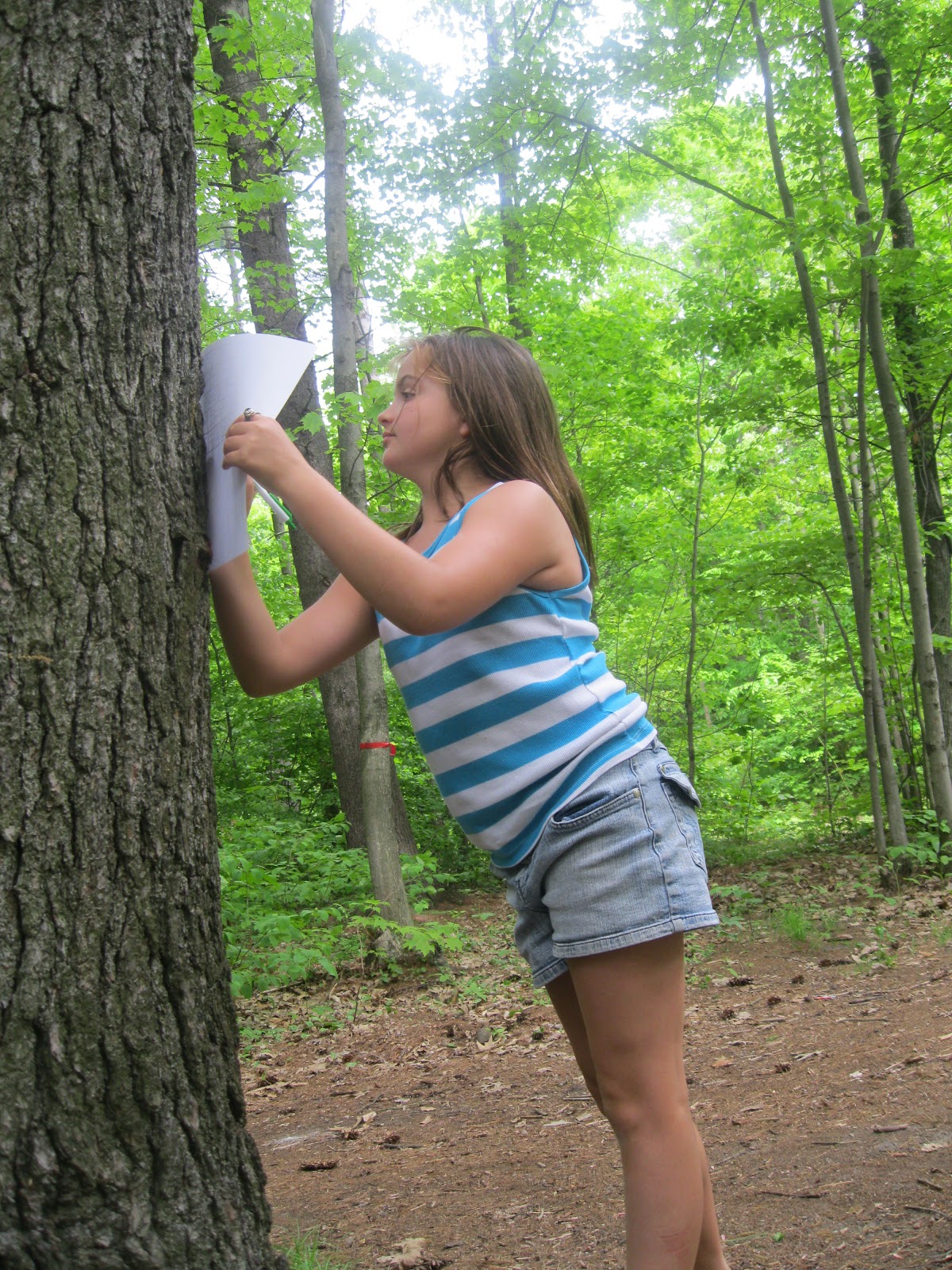
We did have to discuss what "invertebrate" meant, and what examples of behavior we saw count as defense mechanisms. Which was perfect because the point of this activity was to raise questions and creative ideas. For example, the little lady used herself to fill the categories of omnivore, two-legged animal, and mammal. 

She asked for a hard surface to write on,
I told her where to find one.

At one point the little lady pointed at me and said "I see a two-legged mammal right there!" At which her friend pointed at both of us, saying "I see two!" Our third friend, who had wandered off a bit looking for snags, called back "I see three, and they're laughing like crazy people!"

As we walked back to the school all three of the girls looked for a black birch tree so they could chew on the end of a twig and taste the sweet wintergreen like we did last week.