Showing posts with label Plants. Show all posts

Monday, July 21, 2014

New "Simple" Dichotomous Key

I made a new, improved simple key for tree identification. It's geared to narrow down some of the common types of trees in Vermont, in a simple, kid-friendly way. Print off a copy, try it out, and let me know what you think! If you have trouble with it, let me know and I can help you out.


Then, once you get good at using the simple dichotomous key, you can continue to improve you tree identification skills with a more detailed key. There are many available in book form and online, I would suggest trying a few out to see what style works best for you.

Happy identifying!
~Lisa

Saturday, June 30, 2012

Milton Camp

We had an amazing week! I ran a "From the Ground Up" program in Milton, and we learned and explored and played all over the park. As the name (and previous version of the program) suggests, we started out on the first day talking about soil, geology, and hydrology, worked up to plants and trees, then animals, then weather and astronomy. We looked at how each builds on the foundations provided by the other aspects of the natural world.

We climbed a few trees that blocked the trail

The tidbits that stuck with the children during this week made me smile. For example, after discussing soil layers the first day, all week any leaves were called O layer and any bare soil was the A layer. "Look Lisa, we're walking on the A layer!"

Someone dug this trench and so we were able to see soil layers!

This group's creativity astounded me. I taught them the vocab word "snag" (Remember? A favorite of the little lady's.) Then we reached a fork in the trail, I asked them to "hang a right," and they countered with "don't you mean snag a right?" And when I asked them not to touch something, like an animal that's just minding its own business, they said "Yeah, we should leaf it alone!"

They also liked to call the puddles we passed "frog mansions." I loved that. We spooked a frog into the water, and then found it under the mud. It was amazing, the frog stayed stock-still, even when we were pushing it through the water. It was firmly dedicated to pretending to be a rock. I hadn't seen that before!

They all loved to be able to identify and use jewelweed, because it's so useful if you get a cut, sting, or poison ivy exposure in the woods. Each of them was able to identify it by the end of the second day.

Rubbing jewelweed on a mosquito bite for relief

I had planned on spending most of the time outside, and then some weather happened. Thankfully we had some activities that were better suited to indoors, such as astronomy. I had a map of the stars visible in summer in Vermont for each of them. They used it to design their own constellations that they could actually find in the night sky!

After this activity, one of the girls drew her own star map
and asked ME to design constellations for it.

I also have a secret weapon for making rainy days run smoother, his name is Ned. 


Ned is my personal pet, I just got him this year (he's probably only two years old!) When I asked each of the kids what their favorite part of the week was, they each said, without hesitation, "Holding Ned!"

Another favorite activity was playing "Star-Nosed Mole." While we played a lot of games and activities this week, the kids asked to play a few rounds of this game every day! One girl really loved the game because she was "really into worms." I've never heard that one before, but, whatever floats your boat!

 Look at how smug that worm is, safe from the blind mole (as long as he's quiet!)

The group dynamic really affects the way a lesson goes. I always have a lesson plan, but I stay very fluid so if the kids show particular interests then that's what the lesson will become. For example, we spent a good chunk of time discussing wild edible foods. One of the kids even taught me that you can make a dessert out of the seed pods of timothy grass! We found a lot of wood sorrel, which looks like clovers only has heart-shaped leaves and tastes a bit lemony. We also saw a lot of strawberry plants (with no fruit yet) and blackberries!

The whole week was full of special discoveries and hypotheses:

We saw the difference between sapwood and heartwood as displayed 
where the sap leaked out of this white pine when it was cut. 

We smelled wintergreeny "sweet" (black) birch 

(and tasted it too!)

We saw this GIANT snail!

 (close-up)

Other good finds include a beaver stump near the swamp, some insects with unbelievable coloration, and many, many red efts!


Friday, May 25, 2012

After School: Animals

In our "From the Ground Up" after school program, we've talked about 1) the soil and how it lays foundation for plants, 2) the plants themselves, and now 3) we're talking about what the plants do for animals and vice-versa.

We saw standing dead trees ("snags") and discussed how they provide different habitat for animals than fallen dead trees (for example, birds make their homes in cavities on snags.) 

We talked about detritus (matter that is no longer living) and the organisms that break that down. This really shows that worms and fungi are crucial to our ecosystems, because otherwise the nutrients locked away in detritus wouldn't be made available for new plants.

We looked for wildlife signs (and frogs) in this stream.

We identified some mast trees (trees that produce food for animals, such as white pine cones or beech nuts.) And once we did this, we had pretty much all the vocabulary to play the wildlife BINGO game I designed for just this occasion!

Looking for items on their cards

We did have to discuss what "invertebrate" meant, and what examples of behavior we saw count as defense mechanisms. Which was perfect because the point of this activity was to raise questions and creative ideas. For example, the little lady used herself to fill the categories of omnivore, two-legged animal, and mammal. 

She asked for a hard surface to write on,
I told her where to find one.

At one point the little lady pointed at me and said "I see a two-legged mammal right there!" At which her friend pointed at both of us, saying "I see two!" Our third friend, who had wandered off a bit looking for snags, called back "I see three, and they're laughing like crazy people!"

As we walked back to the school all three of the girls looked for a black birch tree so they could chew on the end of a twig and taste the sweet wintergreen like we did last week.

Monday, May 21, 2012

Local Motion Hike

On Saturday I led a family nature walk with Local Motion at Ethan Allen Park in Burlington, VT. Three lovely families joined us, with their five charming children. I knew I was with a great group when right off one little boy pointed at a Norway maple tree and said "Maple!" He later showed me that he knows oak as well, while looking at a dried leaf on the path.

Maple! 

First off we rolled over a log and found a spider, a worm, and a millipede. We also found and identified some poison ivy before we left the path, so everyone would know what not to touch. There aren't many things in Vermont woods that will hurt you, we are very lucky in that regard!

Examining a millipede

Right next to the poison ivy we found a sprig of jewelweed. This plant is so very useful, the juices in its leaves can even help poison ivy rashes, so you don't have to wait till you get home to start treating it if you're exposed. In my observation jewelweed tends to grow near the plants that cause the harm they can fix, like poison ivy and nettles. Nature is pretty amazing like that!

Pale jewelweed (old photo, it is not in bloom yet this time of year.)

Along the hike we looked at acorn caps from oak trees, and saw a squirrel that might be responsible for eating the acorn out of the cap. We went on a mini scavenger hunt and collected lots of dandelions. We also planted many dandelion seeds with our personal wind power!

Scavenger hunt and dandelion picking in a field

At a very exciting moment in the day, I spotted and caught a toad in the woods. Everyone got a chance to touch it with one finger.

Toad!

Then we finally made it up to the tower, I was so proud of how all those tiny legs walked the whole way. We had a nice rest and enjoyed the view before heading back down.

If you are interested, I have another post on a hike in Ethan Allen Park, with tower photos, that you can read here. I also talk more about jewelweed in a post from a hike up Mount Philo last fall, that post is here.

Saturday, May 19, 2012

After School: Plants

For my after school program this week we took a good look at the plants around us. One of my girls taught us all she knows about ferns (she is very astute!) We looked at the repeating patterns in the fronds, how each segment looks like a miniature of the whole fern itself. And we saw the curled fiddleheads of some young ferns, but none were the right type to eat (you don't want to eat the fuzzy ones!)

(Not one of my personal photos, I got excited talking with the girls 
and forgot to take out my camera...)

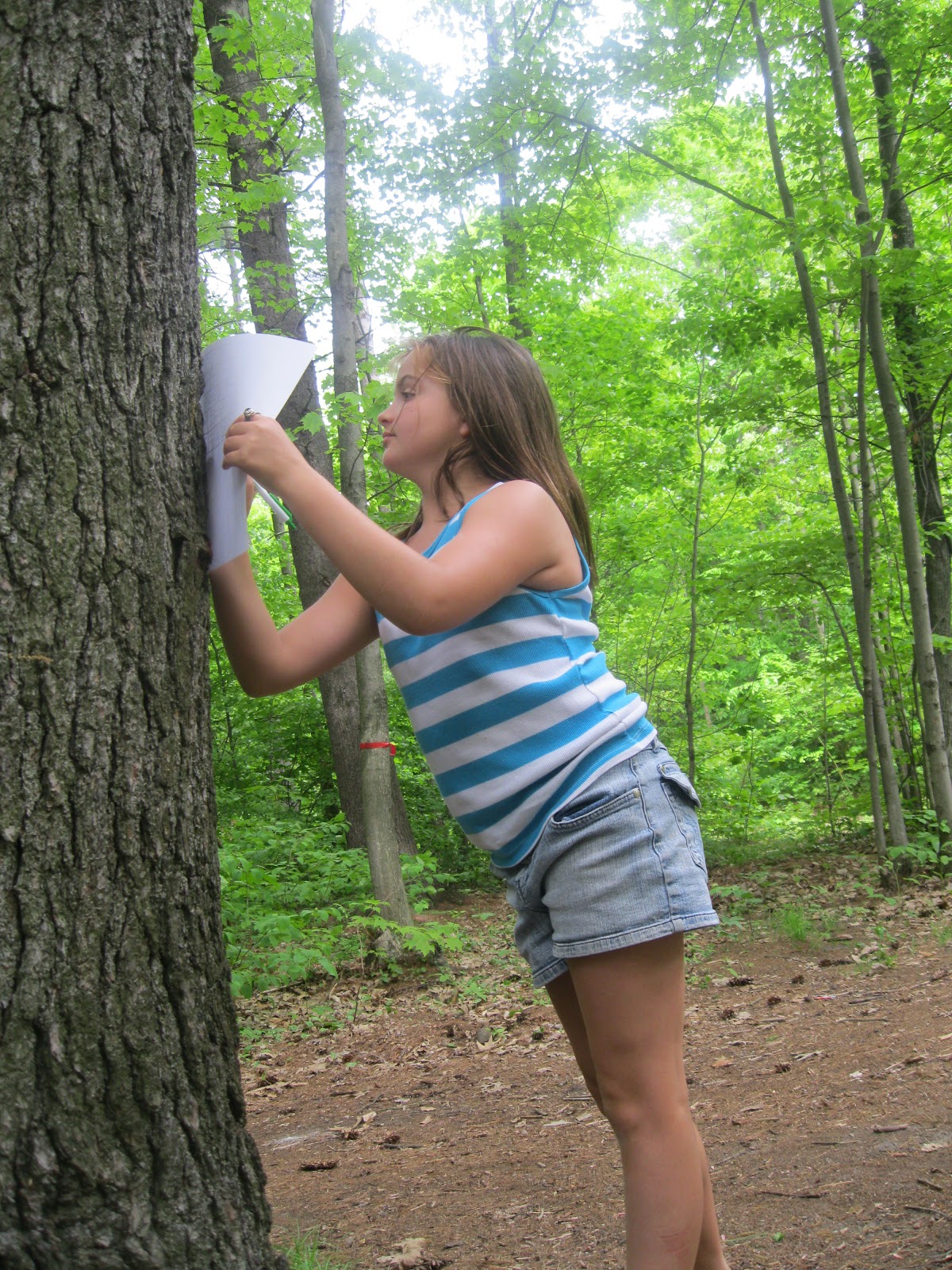
Then we moved up to the trees. I made up a simplified dichotomous key to try out and the girls seemed to really enjoy using it. I explained to them that it's like a "Choose your own adventure" book. If you see a certain characteristic on a tree, you move to a certain question which eventually leads you to the name of the tree you're most likely looking at (the ending of the adventure you chose!)

A fun dichotomous key!

This is a great activity for the 8-9 year olds I'm working with in this group. As for the actual key itself that I made, I'm planning on making some edits to it before I use it again. I realize it'd be easier for children if there are more action verbs at the beginning of each choice:

  • LOOK at the branch, is it...
  • SCRATCH and SNIFF the twig, does it smell like wintergreen? (Then it is black or yellow birch! I'd have to have it lead to a question about the color of the bark.)
The hour went by really quickly, I could talk trees all day! The girls particularly liked learning about the black birch and cherry trees because of their distinctive smells (a cherry twig will smell a bit almondy and I think it smells yucky). We even peeled back the bark and tasted the birch, it was delicious! Coming out of the woods each girl told me her favorite tree. One said moose maple, the second birch, and the third beech. I guess the trees we saw made quite an impression!

Next Monday we're going to talk about the animals we can find in the woods at our school.

Wednesday, September 21, 2011

Mount Philo

On Saturday my lovely friend and I took her children for their first hike up a mountain. We chose Mount Philo, since it would not be too hard for the children and, although it is small, it has lovely views.

As we gamboled through the woods, I was pleased to hear the children chattering about the plants around them. The little lady saw a dead tree with many holes in it and proclaimed it a snag. She remembered from our last hike that "Woodpeckers make the holes." Why? "To find insects." What happens to the holes when they are done? "Other animals move in." Not bad for 6 months later!

Near the beginning of the hike we came across such a beautiful specimen of ash, I'll admit I got over-excited. I love ashes, how they shoot up so straight and tall right through the rest of the trees until the top is invisible behind the canopy. The bark is so distinctive with its oblong hexagonal diamonds.

Diamonds!

Thus, inadvertently, this was my pet tree for this hike. We also saw some white pines, which had not been forgotten from last time either. The young gentleman and the little lady counted out the needles for me, 5 per bundle, just like I promised.

This hike was pretty magical in terms of things to see. We discovered fairy homes, tree scars and burls, rocks that had been moved by glaciers, and various types of mushrooms speckled everywhere.

A fairy home

We discussed how sometimes we see a lot of one type of mushroom spread out over an area. It may look like individual mushrooms, but actually they are connected by root-like mycelia that run under their feet. After all my talk of not overwhelming the children with information, here I am discussing glacial erratics and mycelial mats! Luckily for me, the little lady ate it up (though not literally, since the mushrooms were toxic) and the young gentleman was content to listen while he faced the obstacles of roots and rocks our long-legged bodies barely registered.

View of Lake Champlain from the overlook

The children were amazing, never complaining, always pushing toward their goal of reaching the top. And we were all rewarded when we got there, as you can see. Since the children did so well, we told them we want to hike another mountain. We want to do Snake Mountain next (slightly larger than Philo, but the children proved themselves!)

Showing the children the next mountain we'll hike, Snake Mountain. Wait, hold on...

that one!

On the way down we found some patches of jewelweed, otherwise known as touch-me-not. I'd shown the kids this plant before, so they were very excited.

Pale jewelweed

For your information, not only are the leaves good for insect bites and poison ivy, but the mature seed pods burst to the touch, shooting seeds like they were spring-loaded! It happens to be the right time of year, and there were plenty of good, ripe, bean-looking pods.

"I love exploding touch-me-not!" ~The little lady

Friday, September 16, 2011

An Early Spring Day

I am lucky to live near some diverse natural areas. One of these is a bog which you can walk into via a boardwalk and see some interesting carnivorous plants. I went out there one day this spring with my friend and her children.

On the hike in, through the woods, I chose one or two plants to point out to the kids. I chose ones I knew were interesting and would be memorable for specific reasons. Take the example of white pine. The needles are much different from any other evergreen in the area, long and thin, so it would be easy for them to recognize. Also the kids could enjoy counting off the 5 needles per bunch that identify white pine from the other pines.

Counting needles with the children

I chose to use only one or maybe two trees as an example in order to give the kids a taste of tree identification without overwhelming them, or having them become bored with the idea. As we walked through the forest I was able to point to white pines and say "What kind of tree is this?". The children would run up to count bunches in order to be sure before informing me it was their new friend the white pine. They were so excited to know this and had such satisfaction in exhibiting their new skills, they will remember that and want to learn the next tree when we go hiking again.

On the boardwalk

Once we got to the bog I got to teach the kids about carnivorous plants and why some plants need to get their nutrients from food, like we do, rather than soil like other plants. As you can see it was still early spring with a lot of dormant plants, but we did get to see several lovely pitcher plants. The children really enjoyed it, they were so psyched about the nature walk they asked us to take them to another park before going home.

On our second adventure of the day we walked through the woods to a beach on the lake, which was beautiful and still slightly iced over. Again, I chose one vocabulary word to bring home. When the little lady pointed out a standing dead tree, I let her know she could call it a "snag" and how important it was for wildlife. Later on the hike she saw another, "What's this, it's a sn...what's the word?" After that first reminder she had it down and was pointing out every snag she found.

Then we found a big sheet of birch paper and made it the rest of the way back jumping over residual snowbanks!